

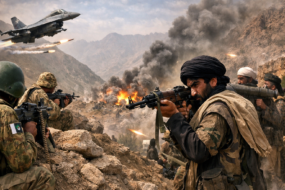
Tensions between Pakistan and Afghanistan escalated sharply after Pakistan reportedly carried out a drone strike on an Afghan military position near the Paktia-Kurram border. The latest strike follows nearly 14 hours of sustained Pakistani air operations targeting what Islamabad describes as Taliban-linked positions inside Afghan territory.
The growing confrontation marks a shift from militant-focused clashes to direct state-level military engagement. Analysts note that Pakistan has increasingly prioritised air power and drone warfare instead of large-scale ground incursions — a strategy that echoes previous regional conflicts where aerial campaigns were used to limit troop deployment.
Afghan authorities claim their forces have launched retaliatory strikes, with some reports suggesting operations extending close to Pakistani territory. Both sides have announced significant casualty figures — Afghanistan alleging 55 deaths from Pakistani strikes, while Pakistan claims 150 fatalities from Afghan attacks. These numbers remain unverified.
From Militant Clashes to State Confrontation
What initially began as tensions involving the Tehreek-e-Taliban Pakistan (TTP) has now expanded into a broader military standoff between Islamabad and Kabul. Pakistan has long accused Afghan authorities of allowing TTP militants to regroup and conduct cross-border attacks. Kabul has consistently denied those accusations.
The situation worsened after the Taliban regained control of Afghanistan in August 2021, when several imprisoned TTP militants were reportedly released. Since then, cross-border violence has intensified periodically.
The Durand Line: A Historic Flashpoint
Beyond militant activity, the long-standing dispute over the Durand Line continues to fuel hostility. Established in 1893 between British India and Afghanistan, the 2,670-kilometre border was inherited by Pakistan after independence in 1947. Afghanistan has historically contested its legitimacy.
The boundary divides Pashtun tribal communities, creating a sensitive political and social fault line. Even in the absence of militant tensions, disagreements over border recognition have repeatedly triggered skirmishes over the decades.
Diplomatic Options Remain Uncertain
While international mediation efforts may emerge — with countries like Turkey and Qatar potentially playing facilitative roles — both governments have publicly described the current situation in strong terms, raising doubts about immediate de-escalation.
For now, the conflict appears to be shifting from proxy-driven instability to a more direct and dangerous confrontation between two neighbouring states, with air and drone warfare playing a central role in the unfolding crisis.
One reply on “Pakistan-Afghanistan Conflict Deepens After Fresh Drone Strike Along Border”
[…] Originally published on 24×7-news.com. […]