

Tensions between Pakistan and Afghanistan intensified on Thursday after Pakistan’s Defence Minister Khawaja Mohammad Asif used the term “open war” following renewed cross-border clashes.
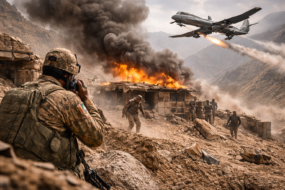
The sharp statement came after a fresh round of violence along the Pakistan-Afghanistan border. Earlier in the day, Afghan forces reportedly carried out retaliatory strikes near the frontier. In response, Pakistan’s Ministry of Information and Broadcasting accused the Afghan Taliban of “unprovoked firing” across multiple locations along the border.
Islamabad maintained that its actions were aimed at protecting its territorial integrity amid repeated security incidents that it says originate from Afghan soil.
The friction centres largely on the 2,611-kilometre Durand Line — a disputed border that Afghanistan has historically refused to formally recognise. In recent months, the region has witnessed repeated exchanges of fire and cross-border operations.
Pakistan’s air force has conducted strikes in eastern Afghanistan, targeting what it describes as hideouts of the Tehrik-i-Taliban Pakistan (TTP) and allied militant groups. Kabul has strongly condemned these operations, calling them violations of its sovereignty.
However, analysts caution that the rhetoric from Islamabad may exceed its actual capacity for sustained conflict.
Military And Economic Constraints
Pakistan’s military is currently engaged in multiple internal security challenges, including operations against the TTP and Baloch insurgent groups. At the same time, the country faces significant economic strain, limiting its ability to sustain a prolonged external conflict.
Islamabad remains reliant on international financial assistance, including support from the International Monetary Fund (IMF), Gulf nations and China. A prolonged military escalation could invite international scrutiny and further destabilise an already fragile regional environment.
While Pakistan claims to have targeted Taliban-linked positions in cities such as Kabul, Kandahar and Paktia, these assertions remain unverified. Afghan authorities have denied significant casualties and have even claimed to have shot down a Pakistani F-16 fighter jet — a claim that also lacks independent confirmation.
Political Signalling Or Strategic Shift?
Observers suggest that the defence minister’s strong language may be intended more as political messaging than a declaration of imminent war. Pakistan has experienced a rise in militant attacks within its territory, including suicide bombings and ambushes allegedly linked to networks operating from Afghan territory.
Officials in Islamabad have repeatedly stated that security forces remain on high alert. The current escalation appears to reflect strategic signalling and pressure tactics rather than preparation for a full-scale military confrontation.
What Lies Ahead?
Despite the heated exchanges, neither side has issued a formal declaration of war, nor has there been evidence of sustained ground offensives. For now, the situation appears to represent an escalation of hostilities rather than the onset of an outright war.
Regional observers believe both governments are seeking leverage amid rising security pressures, while carefully avoiding a conflict that could spiral beyond control in an already volatile region.
One reply on “Pakistan-Afghanistan Border Tensions Escalate After ‘Open War’ Remark, But Full-Scale Conflict Unlikely”
[…] Originally published on 24×7-news.com. […]