

New Delhi: India and Russia are stepping into a new phase of economic cooperation, with discussions underway for a preferential trade agreement that could significantly expand commerce beyond oil and energy.
The first official confirmation of progress came from Moscow, where Russia’s Deputy Prime Minister Alexey Overchuk announced that both sides had concluded the first round of negotiations on a proposed trade pact involving the Eurasian Economic Union (EAEU).
The proposed agreement aims to create a broader free trade framework between India and the EAEU, whose members include Russia, Armenia, Belarus, Kazakhstan and Kyrgyzstan. If finalised, the deal would open up a combined market of nearly 2.2 billion people, offering fresh growth avenues for Indian MSMEs and exporters across the Eurasian region.
Expanding Beyond Energy
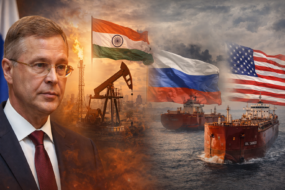
Trade between India and Russia has grown rapidly in recent years, largely driven by energy imports. Bilateral trade reached approximately $68.7 billion in 2024–25, with crude oil forming the bulk of transactions. However, both governments are now looking to diversify cooperation into pharmaceuticals, agriculture, industrial machinery, chemicals and technology.
The long-term objective set by New Delhi and Moscow is to elevate bilateral trade to $100 billion by 2030. The preferential agreement is seen as a key step toward achieving that target.
Strategic Balance Amid Global Pressures
The development comes at a time when India is actively strengthening trade ties with Western economies, even as it faces renewed scrutiny from Washington over continued energy imports from Russia. Indian officials have reiterated that foreign policy and trade decisions will remain guided by national interest.
Talks with Russia signal that New Delhi intends to maintain strategic autonomy while expanding economic engagement across multiple regions.
Financial and Logistical Reforms
Alongside trade negotiations, both countries are working to increase settlements in national currencies, with greater emphasis on rupee–ruble payment mechanisms. This shift is partly aimed at reducing exposure to Western sanctions and banking restrictions.
Infrastructure cooperation is also being enhanced through the International North-South Transport Corridor (INSTC), a logistics route designed to cut transit time and lower freight costs between South Asia and Eurasia.
Officials from both sides have expressed confidence that the trade pact could be finalised within a practical timeframe, laying the groundwork for a broader economic partnership that extends well beyond oil.
One reply on “India, Russia Move Beyond Oil Trade; Preferential Pact with Eurasian Bloc on the Horizon”
[…] Originally published on 24×7-news.com. […]
Comments are closed.