

India’s second successful test of the K4 Submarine Launched Ballistic Missile has triggered concern within Pakistan’s strategic and security establishment, with a former senior military official calling it a “red flag for global stability”.
Zahir Kazmi, former brigadier of the Pakistan Army and Arms Control Adviser at the Strategic Plans Division, criticised the missile test, claiming it could accelerate an arms race in the Indian Ocean Region. Writing on social media platform X, Kazmi said the test significantly strengthens India’s sea-based nuclear deterrence beyond what he described as “regional needs”.
He argued that India’s growing nuclear and missile capabilities — including longer-range ballistic missiles and an expanding nuclear submarine fleet — could destabilise maritime security. According to Kazmi, India is working toward a near-continuous at-sea nuclear deterrent by deploying multiple nuclear-powered ballistic missile submarines (SSBNs) and nuclear-powered attack submarines (SSNs).
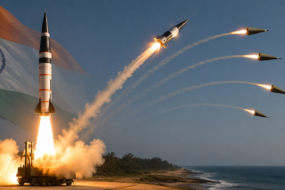
India recently test-fired the K4 missile from INS Arighaat off the coast of Visakhapatnam. With a range of approximately 3,500 km, the K4 significantly extends India’s reach compared to the earlier K15 missile, enabling coverage of all of Pakistan and large parts of China. The Defence Ministry has not issued an official statement on the test.
India’s nuclear submarine fleet is powered by indigenously developed reactors built by the Bhabha Atomic Research Centre, which also supports INS Arihant, the country’s first nuclear ballistic missile submarine. The induction of INS Arihant in 2016 completed India’s nuclear triad — the ability to deliver nuclear weapons from land, air, and sea — strengthening its second-strike capability under a declared no-first-use doctrine.
Kazmi further claimed that India’s military posture has shifted toward sea-led operations following Operation Sindoor, pointing to carrier strike group deployments and BrahMos-equipped naval platforms in the Arabian Sea. He also questioned India’s strategic partnerships with the United States, including agreements such as COMCASA and BECA, alleging that they weaken the global non-proliferation regime.
Pakistan, meanwhile, has been advancing its own naval nuclear capabilities. It tested the Babur-3 Submarine Launched Cruise Missile in 2017 and 2018 and is expanding its submarine fleet, including the induction of Chinese-built Hangor-class submarines. According to the Stockholm International Peace Research Institute, Pakistan currently possesses an estimated 170 nuclear warheads.
The developments come amid heightened India–Pakistan tensions following the May 2025 military confrontation triggered by a terror attack in Pahalgam. While Islamabad accuses India of destabilising the region, New Delhi maintains that its strategic capabilities are defensive in nature and essential for credible deterrence.

One reply on “Pakistan Raises Alarm Over India’s K4 Missile Test, Warns of Arms Race in Indian Ocean”
[…] Originally published on 24×7-news.com. […]
Comments are closed.